
New York City Minerals
Background: Over the past century plus, The New York Mineralogical Club has amassed a huge collection of minerals, with donated specimens, purchased, collected, and bartered for by its members. The minerals of New York City (NYC) were formed at great depth in the earth during and after primary high grade metamorphism of their bedrock hosts. Various native metamorphic rocks that underlie the city, including marble, quartzite, schist, gneiss, granofels, and amphibolite, show the effects of numerous phases of mineralization. Commonly developed during metamorphic recrystallization, metasomatic reactions, along faults and within contact zones of crosscutting igneous rocks, these historic mineral specimens were collected (many over a hundred years ago) during construction of the city's infrastructure. They are a legacy to the natural beauty of a now overdeveloped cosmopolitan area.
Looking down the crowded streets and avoiding speeding cabs, we can lose track of the slow, inexorable geologic development of our area or of the effects of glaciers that recently (less than 12,000 years ago) honed the earth's surface. In NYC, all of the bedrock units now exposed at the earth's surface, were subjected to two episodes of high pressures and great, fusing temperatures, formerly existing in the depth range of 25-40 km (~15-25 miles). The crystalline bedrock that forms the solid underpinning of New York's magnificent skyline has been exhumed from these great formative depths. Controlled by the bulk chemistry of the host rocks and the reactive chemical nutrients of penetrating active fluids, mineralization has left a trail marker of changed geological conditions. They have resulted in formation and subsequent erosion of the Appalachian mountains during roughly 1.1 Billion years of protracted Proterozoic and Paleozoic mountain building.
Geologists use mineral assemblages in rocks of the earth's crust in much the same way that a race-car driver (or average NYC motorist, for that matter) would use an instrument cluster in their vehicle to gauge performance. We, as geologists, use the textures- and minerals in rocks as "gauges" to estimate past variations in strain patterns and changing crustal position in an effort to reconstruct ancient mountain building events. Comments below on the individual specimens are attached for educational purposes only and are the result of carefully examining the specimens within the context of our decades of field examination of the bedrock of NYC. The captions are written and copyrighted by Dr. Charles Merguerian of Duke Geological Laboratory and Hofstra University and are available for any not-for-profit educational purpose possible. We are indebted to the New York Mineralogical Club and the American Museum of Natural History for permission to examine, photograph, and "electronically" publish these images for all mineral collectors, and admirers of natural beauty the world round to enjoy.
Technical details:*Olympus OM-2 camera with 50mm f 3.5 Macro lens using Ektachrome Tungsten ASA 160 color slide film. Kodak processed slide images scanned at 600 dpi and then converted using PhotoShop into .jpg images. U.S. Jefferson nickel added for purpose of scale. We are indebted to Joseph Peters, Glenn Curtis, and John Betts for permissions and direct assistance in completing this foray into the archives of the American Museum of Natural History. These images are intended for non-commercial enjoyment only. All rights reserved [© 2000] by the New York Mineralogical Club and Duke Geological Laboratory. Photographed, in March 1998, by Charles Merguerian at the American Museum of Natural History.
Attribution: Comments on the individual specimens are attached for educational purposes only. The captions are written and copyrighted by Dr. Charles Merguerian of Duke Geological Laboratory and Hofstra University and are available for any not-for-profit educational purpose. We are indebted to the New York Mineralogical Club and the American Museum of Natural History for permission to examine, photograph, and electronically publish these images.
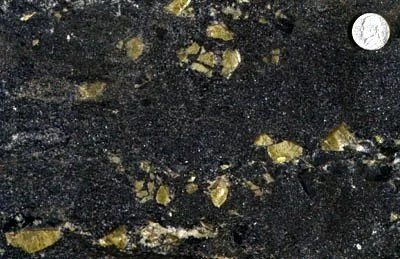
Titanite (Sphene) - Titanite, a calcium titanium silicate is a common accessory mineral in amphibolite and marble units of NYC. The word sphene is derived from the Greek word for wedge, an allusion to the common habit of the mineral. Here, green-colored crystals are from amphibolitic subunits of the Manhattan formation in the Fort George area of northern Manhattan. Kunz Collection #587.
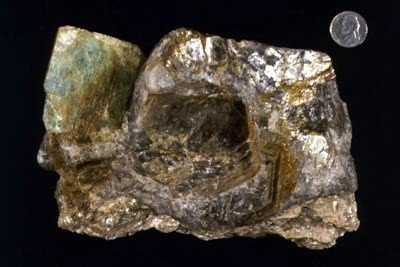
Beryl - Large beryl crystals are not uncommon in granitoid dikes and veins which crosscut the region. During WWII huge amounts of New England beryl crystals were mined and stockpiled for the war effort as it is an important ore for light and strong beryllium metal for avionics. Beryl, in its various forms (aquamarine, emerald, heliodor, morganite) is also utilized as a gemstone. This specimen of greenish-blue beryl was found at 157th Street and Broadway. Manchester Collection # 1227.
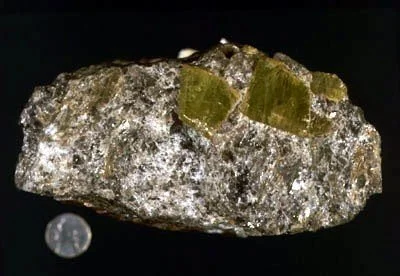
Chrysoberyl - One of the more spectacular specimens collected from the bedrock of New York City. Chrysoberyl is a rare, complex beryllium aluminosilicate that occurs in granitic rocks and pegmatites and in mica schist. This chrysoberyl cluster is associated w/ smoky quartz, garnet, plagioclase, and kyanite (retrograded to muscovite pseudomorphs). Used exclusively as a gemstone, the varieties of cymnophane and alexandrite are of considerable value. Specimen from 93rd Street and Riverside Drive. Chamberlin Collection #690.
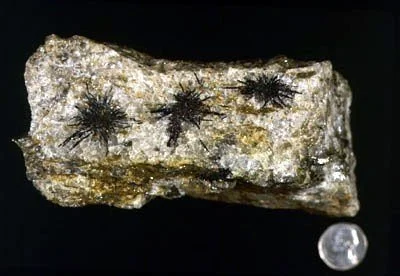
Black Tourmaline - Sprays of black tourmaline (schorl) are commonly the result of boron-rich granitic vapors seeping along small fractures and openings in NYC bedrock. This specimen from 170th Street and Amsterdam Avenue. Kunz Collection #630.
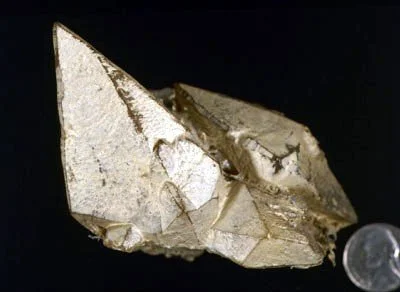
Calcite - Large twinned scalenohedron of calcite, a common carbonate mineral but uncommon in this size and form. Specimen collected from E.174th Street and G'D Blvd., The Bronx. Manchester Collection #757.
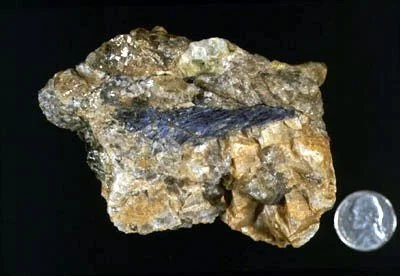
Dumortierite - A rare borosilicate pegmatite mineral found in association with high temperature metamorphism, dumortierite is best known for its use in high-grade porcelain (including spark plug manufacture). Little known from the east coast, important deposits of dumortierite exist in Rochester and Oreana, Nevada. This blue fibrous, radiating specimen, which is associated with a quartz-, albite-, and K-feldspar rich pegmatite, was found at 118th Street and Fifth Avenue. A. C. Hawkins Loan #X-15.
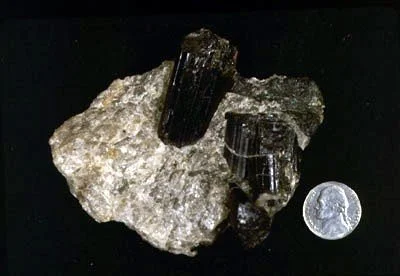
Black Tourmaline - Throughout New England, black-colored tourmaline (variety schorl) is found in association with granitoid dikes and other small injections into metamorphic wallrocks. This crystal specimen is in smoky quartz from 105th Street and Fifth Avenue. Chamberlin Collection #663.
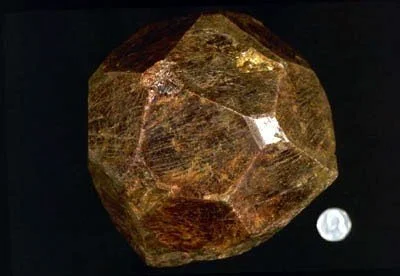
Famous Kunz "Subway? or Sewer?" Garnet - Weighing in at roughly nine pounds and used for years as a door stop at the Department of Public Works, this garnet dodecahedron is the most famous mineral specimen from Manhattan Island. Rumored to have been found in an excavation for the subway system, according to an article by mineralogist John Betts, the large garnet was found August 1885 by a laborer digging a sewer at 35th Street and Broadway. According to Manchester and Stanton (1917) the garnet was found free from matrix. Kunz specimen and collection. American Mineralogist article - Manchester and Stanton (1917) Discovery of Gem Garnet in New York City
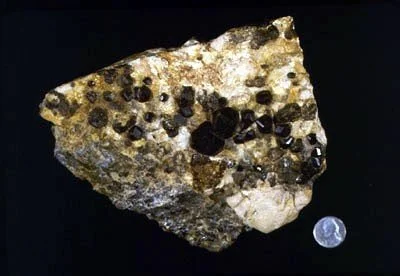
Almandine Garnet - A very common accessory mineral in the rocks of NYC as a result of contacvt metamorphism and dynamothermal metamorphism of aluminous rocks. This specimen was found at 65th Street and Broadway. Kunz Collection #188.
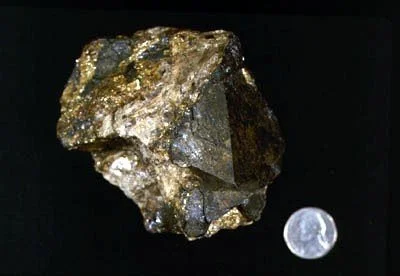
Magnetite - A large octahedral crystal of magnetite in matrix found at 176th Street and Broadway. Manchester Collection #1191
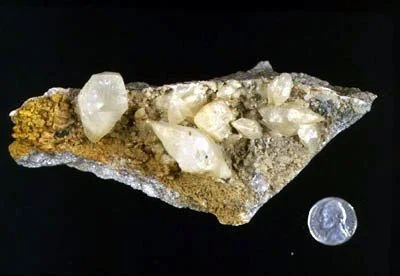
Calcite - Nicely formed scalenohedral calcite crystals here found in a small cavity in schistose marble. Specimen found near E.174th Street and G'D Blvd., The Bronx. Manchester Collection #757.
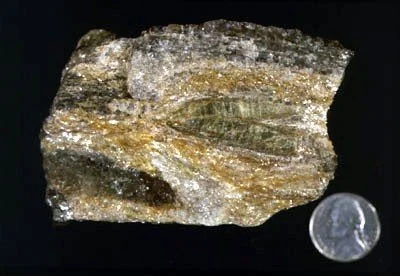
Beryl - Tapered green beryl crystals found in aluminous schist of the Hartland Formation exposed along 94th Street and Riverside Drive. Note the filled fractures parallel to the basal cleavage of the crystals. J. A. Grenzig Collection #X-40, 1899.
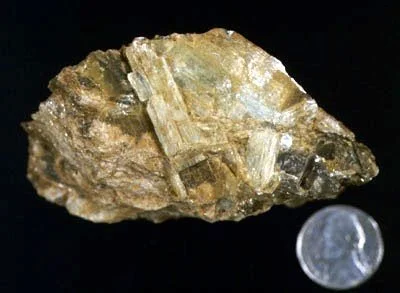
Kyanite - A high pressure aluminosilicate mineral very common to the bedrock units of NYC. It occurs in nodules intergrown with quartz and magnetite and in idioblastic clusters in quartz veins (as pictured here). Clearly similar in quality to the famous Judd's Bridge locality in Connecticut, these crystals are partly replaced by muscovite (a retrograde metamorphic effect). The specimen and the Hartland host rocks were found near 94th Street and Riverside Drive. J. A. Grenzig Collection, 1899.
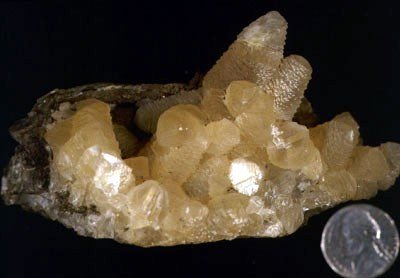
Calcite - Found in association with the Inwood Marble formation, these yellowish crystals were found in a cavity in the Inwood Marble near 174th Street and G'D Blvd., The Bronx. Manchester Collection #750.
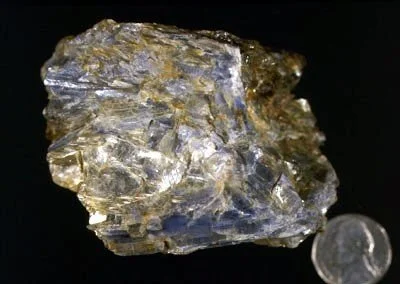
Kyanite - The phenomenal deep blue color of this specimen is atypical for kyanite found in NYC. Similar to gemmy specimens from Minas Gerais, Brasil, this specimen, crystallized in vein quartz, was located at 61st Street and Central Park. E. Schernikow Collection #127.
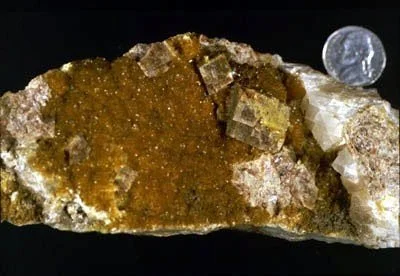
Chabazite and Stilbite - Chabazite crystals (a zeolite) roughly 1 cm on edge highlight this view of gneissic rocks found at 45th Street and Second Avenue. Chamberlin Collection #107.
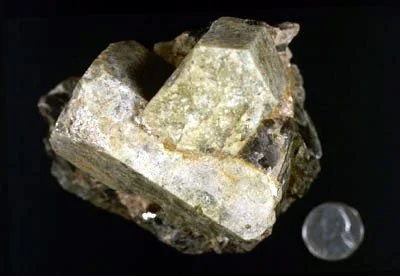
Beryl - Large interpenetrant beryl crystals, these found at 190th Street and Amsterdam Avenue, are commonly associated with granitoid dikes and pegmatite throughout the New England Appalachians. Kunz Collection #69.
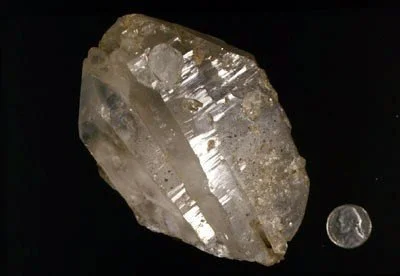
Quartz - A phenomenal parallel-growth crystal from The Bronx found near Westchester Avenue. Large crystals such as these are found along fractures or faults but are uncommon in NYC. Barros Collection #18662.
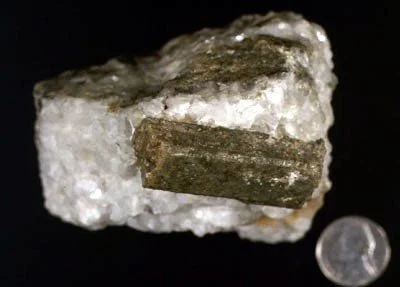
Malacolite - An older term for diopside, a calcic clinopyroxene. Here a deep green euhedral porphyroblastic crystal sits atop crystalline marble. Unknown locality but probably upper Manhattan (Harlem Ship Canal?). Manchester Collection #696.
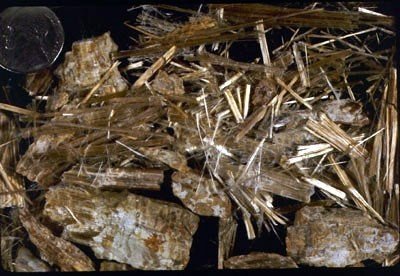
Chrysotile - A dangerous member of the serpentine group of minerals, fine high-aspect-ratio acicular crystals of chrysotile are known irritants to human lung- and stomach tissue. Prolonged exposure can lead to lung cancer. As such, do not breathe in to close to, or lick, your monitor on this one! The result of metamorphism of ultramafic rock, these matted crystals were collected at 81st Street and Eighth Avenue. In the Hartland formation, lenses of highly sheared serpentinite are found. This "lost locality" may be genetically similar to chrysotile reported from Staten Island.
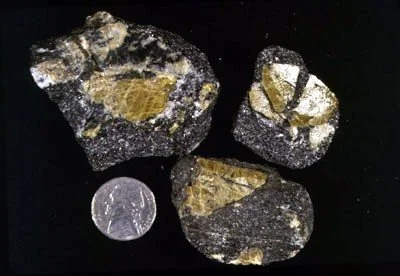
Titanite (Sphene) - Beautiful green-colored "gemmy" crystals, similar to the very first specimen pictured above, are formed in amphibolite. These specimens collected from 167th Street and the Harlem River. E. Schernikow Collection.
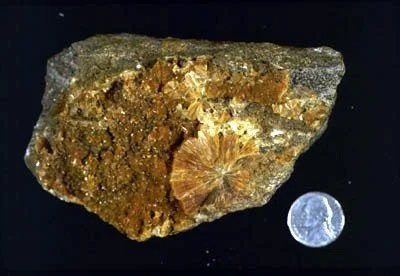
Stilbite - A member of the zeolite group, this radiating specimen of stilbite hails from 44th Street and Second Avenue. Stilbite is a common mineral in NYC found in association with faults and fault zones. Chamberlin Collection #562.
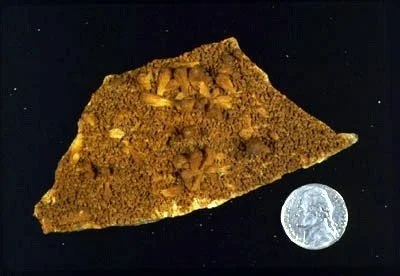
Stilbite - Scopiform stilbite crystals, again from the vicinity of 45th Street between First and Second Avenue. Stilbite is a common mineral in NYC found in association with faults and fault zones. Chamberlin Collection #582.
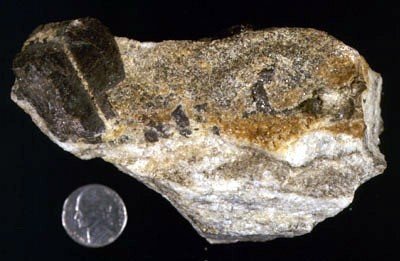
Sphene - A common accessory mineral in igneous and metamorphic rocks, this wedge-like specimen of sphene exhibits a dark-brown color in a schistose calcareous host rock. from the Harlem Ship Canal. No other details.
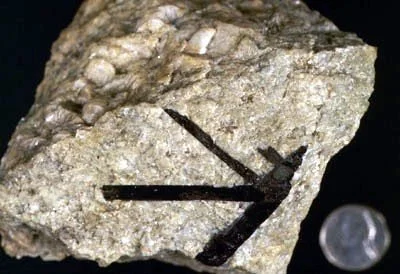
Tourmaline - Interpenetrant crystals of tourmaline (var. schorl) collected from Hunt's Point, The Bronx. NYC Department of Water Supply gift. Technical details: Olympus OM-2 camera with 50mm f 3.5 Macro lens using Ektachrome Tungsten ASA 160 color slide film. Kodak processed slide images scanned at 600 dpi and then converted using PhotoShop into *.jpg images. U.S. Jefferson nickel added for purpose of scale. We are indebted to Joseph Peters, Glenn Curtis, and John Betts for permissions and direct assistance in completing this foray into the archives of the American Museum of Natural History. These images are intended for non-commercial enjoyment only. All rights reserved [© 2000] by the New York Mineralogical Club and Duke Geological Laboratory. Photographed, in March 1998, by Charles Merguerian at the American Museum of Natural History. Contact Us E-mail Us: info@dukelabs.com